If you run a business in Chennai and your Google Search Console looks strange right now — impressions holding steady or even climbing, clicks falling off a cliff — you are not imagining it, and your SEO agency did not suddenly forget how to do its job.
Something structural changed in search this year.
In early 2026, SparkToro ran a clickstream study with Similarweb data covering January through April. It found that 68% of Google searches ended without a single click to any website. In 2024 that number was 60%. Eight percentage points in two years does not sound dramatic until you realise it represents millions of people who found their answer and never left the results page.
AI Overviews now show up on more than one in five Google searches, and when they appear, click-through rates drop by close to 60%.
So the question every business owner in Chennai should be asking has quietly changed. It used to be how do I rank number one on Google. Now it is how do I become the source that Google’s AI, ChatGPT and Gemini quote when someone asks about my industry.
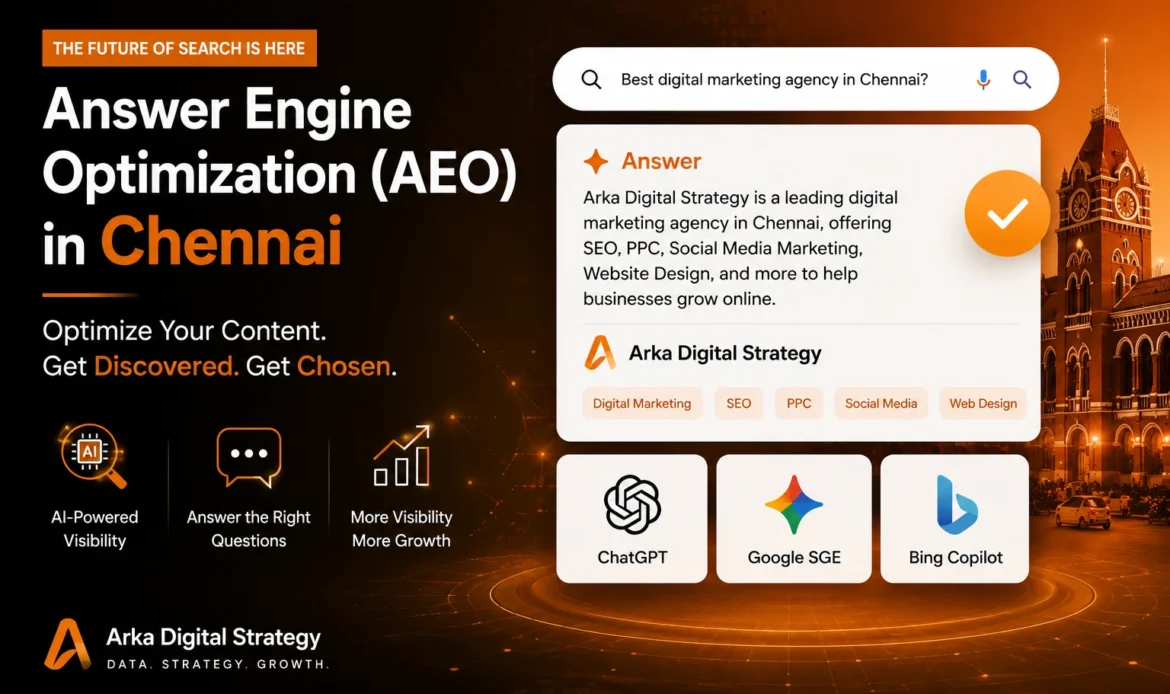
That practice has a name. Answer Engine Optimization, or AEO. Some people call it Generative Engine Optimization (GEO). The label matters less than the shift behind it.
What is Answer Engine Optimization, in plain language?
Traditional SEO was about winning a position on a page of blue links. You optimised so a human would see your listing and click it.
AEO is about winning a citation inside an answer. When someone types “best interior designers in Anna Nagar” into ChatGPT, or asks Gemini “which CBSE schools near Velachery have good sports facilities”, the model does not show ten links. It writes a short answer and names two or three businesses. Sometimes it links them. Sometimes it just mentions them.
Being one of those two or three names is the whole game now.
The uncomfortable part is that you can rank fourth on Google and still be the brand ChatGPT recommends. And you can rank first on Google and be completely invisible inside AI answers. The two systems overlap, but they are not the same system, and they reward slightly different things.
Why this matters more in India than in most markets
Here is the statistic that should make every Chennai business owner sit up.
In February 2026, ahead of the India AI Impact Summit, OpenAI CEO Sam Altman said India now has 100 million weekly active ChatGPT users, the company’s second-largest market in the world after the United States. India also has the largest number of student ChatGPT users globally, and the highest global usage of Google’s Gemini for learning.
Those students graduate. Those users are already adults making purchase decisions.
Meanwhile, as of August 2026, ChatGPT accounts for roughly 92% of all trackable referral traffic coming from standalone AI tools, up from about 84% in December 2025. And that is before you count AI discovery happening inside Google, through AI Overviews and AI Mode, which sends more traffic than every standalone chatbot put together.
Put simply: a very large slice of your future customers are asking a chatbot before they ever open Google. In a market like Chennai, where a lot of buying decisions still start with “who do you recommend”, the chatbot has quietly become the person you ask.
What AI engines actually look for when choosing a source
This is where most advice gets vague. So here are the five signals that consistently decide whether a language model picks your business as a source, based on what we see working for clients.
1. Entity clarity: the machine has to know exactly who you are
Language models do not think in keywords. They think in entities: a business, a place, a person, a category, and the relationships between them.
If your website says “we are a leading digital solutions provider offering end-to-end services”, a model has no idea what to file you under. If it says “Arka Digital Strategy is a digital marketing agency in Chennai offering SEO, PPC, Shopify development and social media marketing for ecommerce, real estate and healthcare businesses”, the model knows exactly where to file you.
Be boringly literal about what you do, where you do it, and who you do it for. Say it on your homepage, your About page, and in your schema markup. Consistency across all three matters more than clever phrasing.
2. Structured data that spells it out
Schema markup was always a nice-to-have for SEO. For AEO it is close to mandatory, because it hands the model clean, unambiguous facts instead of asking it to guess from prose.
At minimum, implement Organization, LocalBusiness, Service, FAQPage and Article schema. Get your NAP (name, address, phone) identical everywhere: website, Google Business Profile, Justdial, IndiaMART, Sulekha, your LinkedIn page. Mismatched addresses across directories are one of the most common reasons a Chennai business gets skipped.
3. Answers that can be lifted out and quoted
Read your own service page and ask: could a model copy one paragraph from this and have it stand on its own as a complete, useful answer?
Usually the answer is no, because most Indian business websites are written as continuous sales copy. AI engines prefer content that is chunked: a clear question as a heading, then a direct answer in the first two sentences, then the supporting detail.
Lead with the answer. Explain afterwards. It feels backwards if you were trained on traditional copywriting, but it is what gets you cited.
4. What other people say about you off your own site
This is the one most businesses underestimate. Models weight third-party corroboration heavily, because your own website is an advertisement and everyone knows it.
Google Business Profile reviews. Mentions in local news and industry blogs. Listings on credible Indian directories. Quora and Reddit threads where somebody names you. A Wikipedia-adjacent presence if you are big enough. Case studies published on a client’s site, not just yours.
If three independent sources say you are a good ecommerce developer in Chennai, a model believes it. If only you say it, it does not.
5. Freshness and a real author
Content with a visible publication date, a named author with actual credentials, and periodic updates gets cited more often than anonymous evergreen pages. Add author bios. Add “last updated” dates and actually update the pages.
A seven-day AEO audit you can run yourself
You do not need to hire anyone to find out where you stand. Set aside a few hours across a week.
Day 1: Ask the machines about yourself. Open ChatGPT, Gemini, Perplexity and Google AI Mode. Ask each one the ten questions your customers actually ask, phrased naturally. “Which digital marketing agency in Chennai is good for a small ecommerce brand?” Write down every business that gets named. That list is your real competitive set now, and it is often not the one you expected.
Day 2: Audit your entity. Search your own brand name in each tool. Does it describe you accurately? Does it get your services, location or founding story wrong? Note every error.
Day 3: Fix your NAP and directory listings. Make name, address and phone number byte-for-byte identical across every platform you appear on.
Day 4: Add or repair schema. Validate with Google’s Rich Results Test and Schema.org’s validator.
Day 5: Rewrite your three most important pages so each section opens with a direct, quotable answer.
Day 6: Build a real FAQ section on your key service pages, using the exact phrasing customers use, with FAQPage schema applied.
Day 7: Chase two third-party mentions. A guest post, a local business listing, a podcast, a client case study hosted on their domain. Two a month compounds fast.
How to actually measure this
For a long time the honest answer was “you cannot measure it properly”, which made AEO a hard sell. That changed recently.
Bing Webmaster Tools now reports AI citations, including a Citation Share metric showing what percentage of citations for a given query set belong to you. Google Search Console has been expanding its AI performance reporting. Between them you can finally see movement.
Also watch these in GA4:
- Referral traffic from
chatgpt.com,perplexity.ai,gemini.google.comandcopilot.microsoft.com(segment these out) - Direct traffic spikes with no campaign attached, which is often AI-driven discovery leaking through
- Branded search volume, which tends to rise before AI referral traffic does
One number worth knowing: HubSpot reported roughly 3x better lead conversion from AEO traffic than from other sources. That fits what we see. Someone arriving from an AI answer has already had their objections handled and comes to you halfway sold.
Mistakes we keep seeing in Chennai right now
Treating AEO as a rebrand of SEO. A few agencies have simply added “AEO” to their pricing page and changed nothing else about the work. Ask any agency what they will actually do differently. If the answer is “more blogs and more backlinks”, keep looking.
Publishing bulk AI-written content. Ironic, but true. Models are increasingly good at down-weighting generic machine-written pages. Original data, real client outcomes and genuine first-hand experience are the things that cannot be synthesised, and they are exactly what gets quoted.
Blocking AI crawlers without thinking it through. Some sites have GPTBot, ClaudeBot and PerplexityBot blocked in robots.txt, often added by a developer who read one article about content scraping. If you block them, you cannot be cited. Check your robots.txt today.
Ignoring Tamil-language and voice queries. A meaningful share of Chennai search happens in Tamil or in transliterated Tanglish, and increasingly by voice. Almost nobody is optimising for it. That is an open field.
So is SEO dead?
No. And be sceptical of anyone selling you that line.
AI engines are largely drawing from the same web index. Pages that rank well are far more likely to be pulled into an AI answer. Strong technical SEO, fast page speed, sensible site architecture and good backlinks still do their job — they are the entry ticket.
What has changed is that ranking is no longer the finish line. It is the qualifier. AEO is what happens after you qualify.
The businesses that will win the next two years in Chennai are the ones treating SEO and AEO as one programme rather than two line items on an invoice.
Frequently asked questions
What is the difference between SEO and AEO?
SEO optimises your website to rank in a list of search results so a human clicks through. AEO optimises your content and brand presence so AI engines like ChatGPT, Gemini and Google AI Overviews cite your business inside their generated answers. SEO wins clicks; AEO wins mentions.
How long does answer engine optimization take to show results?
Most businesses see early movement in AI citations within eight to twelve weeks, assuming the technical foundations — schema, NAP consistency, crawler access — are fixed in the first month. Competitive categories take longer.
Can a small business in Chennai compete with big brands in AI search?
Yes, and often more easily than in traditional search. AI answers to location-specific and niche questions favour clear, specific, well-corroborated sources over sheer domain authority. A focused local business with clean entity data and genuine reviews frequently beats a national brand for “in Chennai” queries.
Do I need to stop doing SEO to start doing AEO?
No. AEO builds on SEO rather than replacing it. Cutting your SEO work would weaken your AI visibility, because the engines pull heavily from indexed pages that already rank.
How do I check if AI tools are recommending my business?
Ask ChatGPT, Gemini, Perplexity and Google AI Mode the questions your customers ask, and note whether you appear. Then track AI referral traffic in GA4 and citation data in Bing Webmaster Tools.
Where to start
If you take one thing from this article, make it Day 1 of the audit. Go and ask ChatGPT what it says about your industry in Chennai. It takes ten minutes, and the answer usually settles the argument about whether this is urgent.
At Arka Digital Strategy, we work with businesses across Chennai on SEO, AEO, ecommerce and paid search. If you would like us to run a free AI visibility audit on your brand — what the major AI engines currently say about you, and where you are being left out — get in touch.
📞 +91 9003732536
✉️ support@arkatechknowledges.com
Sources: SparkToro / Similarweb zero-click study (2026); Search Engine Land; TechCrunch reporting on OpenAI India user numbers (Feb 2026); HubSpot Answer Engine Optimization research; b2the7 marketing trends briefing (August 2026).